Morse code basics
What Is Morse Code?
Morse code is a character encoding system that turns text into short signals, long signals, and measured spaces. Modern learning and radio references use International Morse Code.
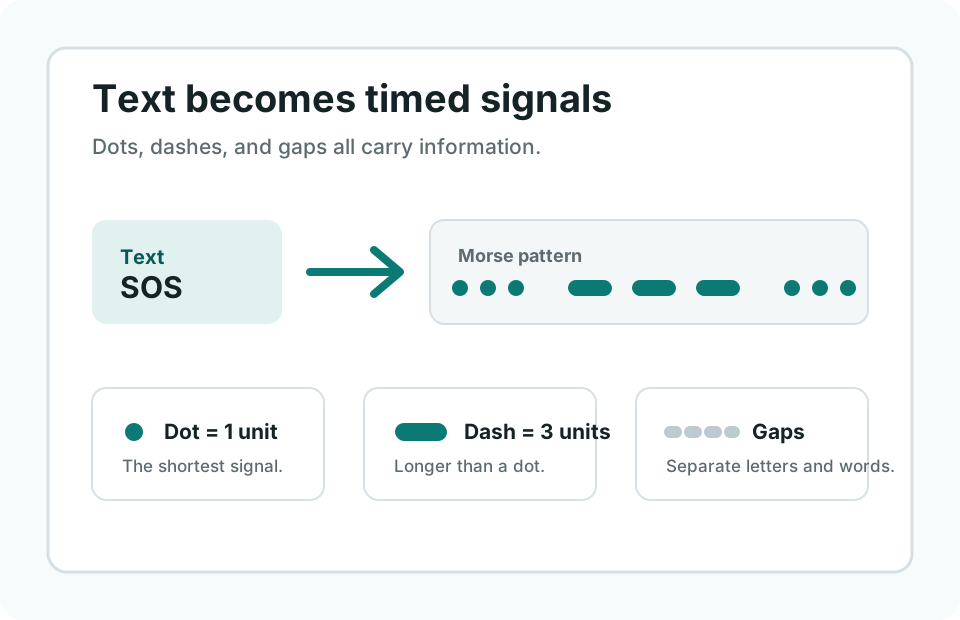
Morse code represents characters as signal patterns.
Morse code is not a spoken language. It is a code for writing messages as signals. A sender takes ordinary text, replaces each character with a sequence of short and long signals, and leaves measured gaps so the receiver can tell where one character ends and the next begins.
A dot is a short signal, a dash is a longer signal, and a pause separates parts of the message. For example, A is .-, S is ..., O is ---, and SOS is "... --- ...". If those gaps are removed or changed, the same dots and dashes may become difficult or impossible to read.
International Morse Code is the version used by this translator, the alphabet chart, the number table, punctuation pages, and practice tools on this site. It is the modern reference most learners mean when they search for Morse code today.
Morse code began as a practical telegraph system.
The original Morse system was built for electrical telegraph lines in the nineteenth century, when a message had to travel over a wire as simple on/off pulses. Instead of sending handwriting or speech, the operator sent timed electrical signals. A short pulse became a dot, a longer pulse became a dash, and the receiving operator wrote the letters back into plain text.
Later, International Morse Code became the common global reference because it simplified several older patterns and worked well across radio. That is why modern charts usually show the International version, while American Morse is treated as a historical railroad and landline code.
Three rules make Morse readable.
1. CharactersEach letter, digit, or supported punctuation mark has a defined dot-and-dash pattern.
2. TimingA dash lasts three times as long as a dot. Correct gaps keep characters and words from running together.
3. MediumThe same pattern can be sent by sound, light, radio keying, written dots and dashes, or on-screen flashes.
The spaces are part of the code.
| Element | Standard timing | Why it matters |
|---|---|---|
| Dot | 1 unit | The shortest sound or flash. |
| Dash | 3 units | Long enough to distinguish from a dot. |
| Inside a letter | 1 unit gap | Keeps the parts of one character together. |
| Between letters | 3 unit gap | Shows where one character ends. |
| Between words | 7 unit gap | Separates words; written examples often use a slash. |
Start with common patterns.
| Text | Morse Code | What to notice |
|---|---|---|
| A | .- | One dot, then one dash. |
| SOS | ... --- ... | A continuous distress signal often written as three letters for readability. |
| HELLO | .... . .-.. .-.. --- | Spaces separate letters. |
Decode Morse one group at a time.
When Morse is written on a page, each letter is normally separated by a space. A slash marks a word break. For example, -- --- .-. ... . / -.-. --- -.. . reads as MORSE CODE. If you try to decode every dot and dash as one long stream, the message becomes ambiguous.
When Morse is heard, the same idea applies through rhythm. You listen for short and long tones, then for the silence between them. Good operators learn the sound of whole letters, not just individual dots and dashes.
A few details prevent bad decoding.
Morse code is case-insensitive: A and a use the same pattern.
A dash is not simply a hyphen typed on a keyboard; it represents a signal three times as long as a dot.
Written slashes are notation helpers. In sound or light, the word break is a longer silence.
American Morse and International Morse are not identical. Modern reference pages usually mean International Morse Code.
Use the right reference for the task.
Quick answers about Morse code.
What is Morse code?
Morse code is a way to represent letters, numbers, and punctuation as short dots, longer dashes, and timed spaces.
How does Morse code work?
Each character has its own dot-and-dash pattern. The receiver reads the pattern, then uses spaces to separate letters and words.
What is International Morse Code?
International Morse Code is the modern standard for Morse letters, digits, common punctuation, and timing rules. This site follows ITU-R M.1677-1.
Is Morse code a language?
No. Morse code is an encoding system. It does not create grammar or vocabulary by itself; it turns existing text into signal patterns.
Can Morse code be sent with light?
Yes. The same dot-and-dash timing can be sent as short and long flashes, which is why Morse can work through sound, light, radio, and written notation.
Sources used for this guide.
ITU-R M.1677-1 defines International Morse code characters and timing rules used by this guide.