Emergency words
Help Morse Code and SOS Meaning
HELP in Morse code is letter-by-letter English. SOS is the recognized distress signal. This guide shows both patterns, how they differ, and when each term is useful for learning.
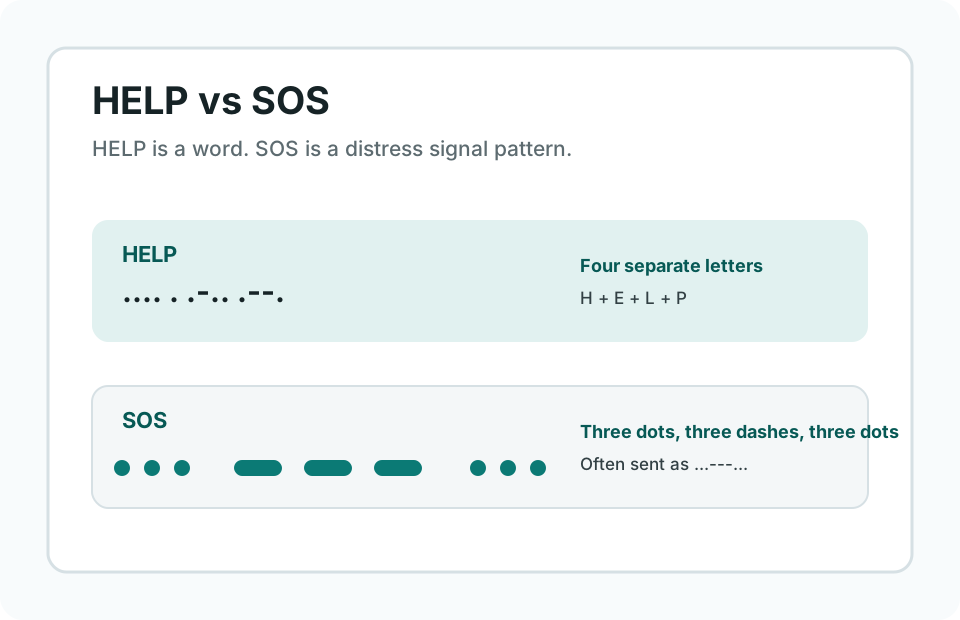
Morse code for help: HELP is .... . .-.. .--.
.... . .-.. .--.... --- ...They are related, but not the same signal.
| Term | Morse Code | Best use |
|---|---|---|
| HELP | .... . .-.. .--. | Learning vocabulary, classroom examples, puzzle clues, and comparing individual letters. |
| SOS | ... --- ... | Recognized distress-signal pattern and emergency reference lessons. |
SOS means a vessel or person is in distress and needs assistance.
In Morse, SOS is simple to recognize: three dots, three dashes, three dots. It is usually written as letters for readability, but the signal is the continuous pattern ...---...
Many people expand SOS as 'save our ship' or 'save our souls.' Those phrases are later memory aids. The authoritative point is that SOS is a distress signal, not a normal word.
The pattern is short, balanced, and hard to confuse.
SOS is memorable because it has a clear shape: short-short-short, long-long-long, short-short-short. A listener does not need to understand English to recognize the rhythm. A viewer can also recognize it as three short flashes, three long flashes, then three short flashes.
By contrast, HELP is a normal word encoded letter by letter. It is easy to understand when written down, useful in lessons and puzzles, and helpful for learning H, E, L, and P. But as a distress pattern, SOS is more compact and internationally recognized.
The same Morse pattern can travel through different channels.
| Channel | Dot | Dash | Important note |
|---|---|---|---|
| Sound | Short beep | Long beep | Keep steady spacing. |
| Light | Short flash | Long flash | Useful for visual practice and demonstrations. |
| Written | . | - | Use spaces between letters and slash between words. |
Emergency-related phrases in Morse code.
HELP: .... . .-.. .--. for learning the word help letter by letter.
SOS: ... --- ... for the recognized distress pattern.
HELP ME: .... . .-.. .--. / -- . for written examples, classroom practice, and puzzles.
NEED HELP: -. . . -.. / .... . .-.. .--. for a longer phrase that shows word spacing.
Morse is useful knowledge, but it is not a substitute for emergency services.
This page is written for learning, reference, and signal literacy. In a real emergency, use the most reliable official channel available: emergency phone service, marine VHF, aviation radio, a personal locator beacon, satellite messenger, or another locally appropriate distress method.
If you practice SOS with sound or light, label it clearly as practice and avoid sending it where it could be mistaken for a real distress call.
Quick answers about HELP and SOS.
What is help in Morse code?
HELP in Morse code is .... . .-.. .--., encoded letter by letter as H, E, L, and P.
What does SOS mean?
SOS is an internationally recognized distress signal. It is commonly read as a call for urgent assistance, but it was chosen for its simple Morse pattern rather than as an original abbreviation.
Should I send HELP or SOS in an emergency?
For learning, HELP is useful vocabulary. For an actual distress signal, SOS is the recognized pattern, but real emergencies should use official emergency channels whenever possible.
Is SOS short for save our souls?
No. Phrases such as save our souls and save our ship are later memory aids. SOS became useful because its Morse pattern is simple and recognizable.
Can I use a flashlight for HELP or SOS?
For practice, yes: use short flashes for dots and longer flashes for dashes. In real emergencies, use official emergency services and reliable distress channels whenever possible.
Sources used for this guide.
ITU-R M.1677-1 is the International Morse code standard used for the HELP and SOS dot-dash patterns.
U.S. Coast Guard Navigation Rules, Annex IV lists distress signals that indicate distress and need of assistance.
47 CFR section 80.317 documents SOS as the radiotelegraph distress signal.
Encyclopaedia Britannica: SOS summarizes the common history of SOS and why it is not originally an abbreviation.